Is 3D Printed Decor Actually Sustainable? A Look at PLA and Made-to-Order Manufacturing
Curious whether 3D printed home decor is really eco-friendly? Learn how PLA filament and made-to-order production reduce waste compared to mass manufacturing.
Is 3D Printed Decor Actually Sustainable? A Look at PLA and Made-to-Order Manufacturing
"Sustainable" gets attached to a lot of products these days, and it's fair to be a little skeptical when you see it on a plastic decor item. So let's actually break down what makes 3D printed home decor different from the mass-produced alternative — and where the sustainability claims genuinely hold up.
The Material: What Is PLA, Really?
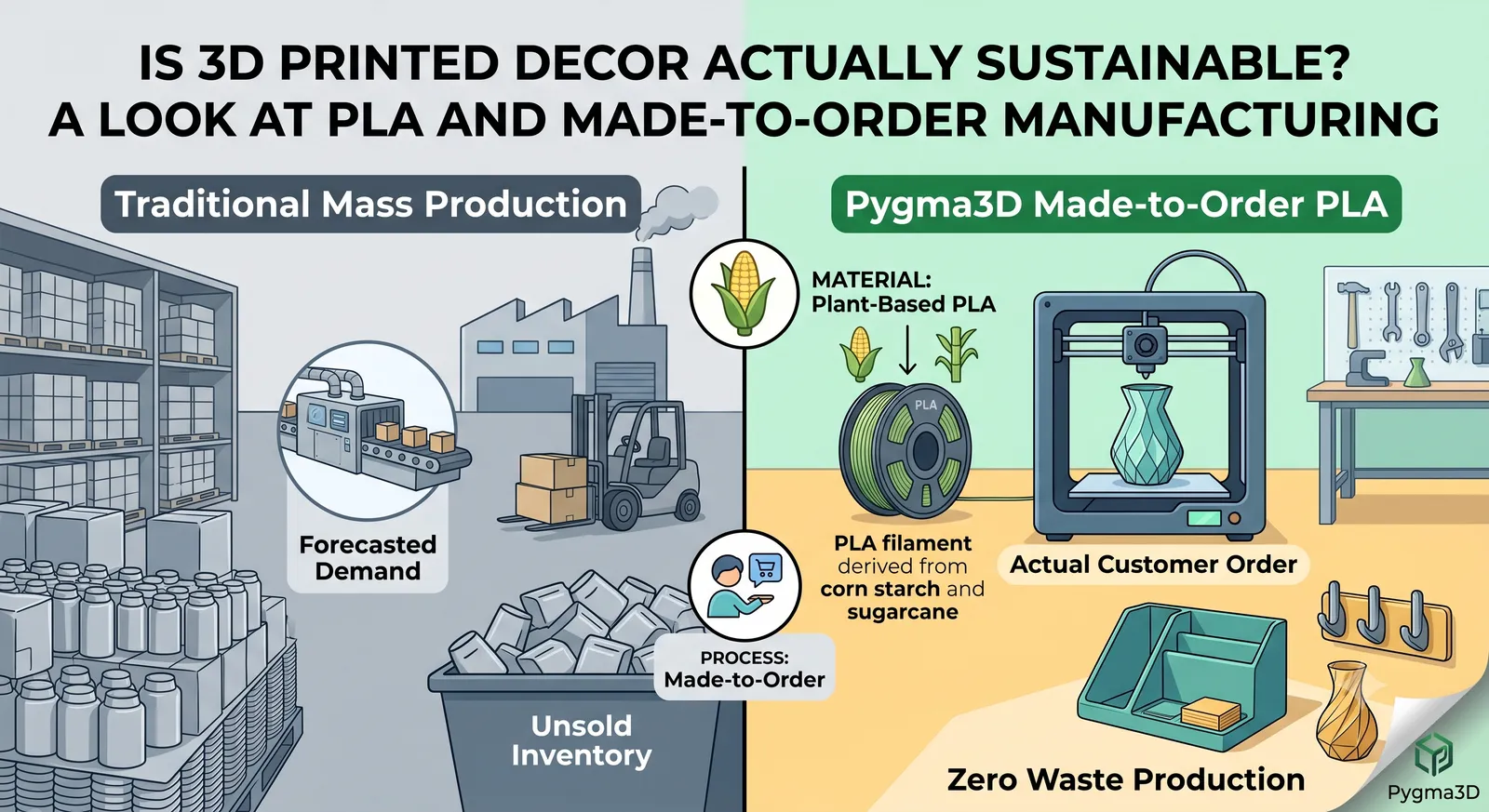
PLA (polylactic acid) is the most widely used material in home 3D printing, and for good reason. Unlike petroleum-based plastics such as ABS, PLA is derived from renewable plant sources like corn starch or sugarcane. It's biodegradable under the right industrial composting conditions, requires a lower printing temperature than most alternatives (which means less energy per print), and doesn't release the strong fumes associated with some other filaments.
That doesn't mean it magically disappears in a home compost bin — like most bioplastics, PLA needs specific industrial conditions to break down fully. But compared to standard injection-molded plastic decor, it starts from a meaningfully more sustainable base material.
The Bigger Win: Made-to-Order Production
Here's the part that often gets overlooked: the material is only half the story. How something is made matters just as much as what it's made from.
Traditional decor manufacturing typically works like this: a factory produces a large batch of a product, ships it to a warehouse, and hopes enough of it sells. Unsold stock gets discounted, stored indefinitely, or eventually discarded. It's a model built around forecasting demand — and forecasts are often wrong.
3D printing flips that model. Because each piece can be printed individually, decor brands can produce made-to-order, meaning nothing is manufactured until a customer actually places an order. There's no warehouse of unsold inventory, no overproduction, and no need to guess how many units of a design will sell this season.
Comparing the Two Models
| Mass Production | Made-to-Order 3D Printing | |
|---|---|---|
| Production trigger | Forecasted demand | Actual customer order |
| Unsold inventory | Common | Effectively none |
| Material | Often petroleum-based plastic | Often plant-based PLA |
| Batch size | Large, uniform runs | Small batches, customizable |
| Design flexibility | Limited, costly to change | High, low cost to adjust |
Does This Mean 3D Printed Decor Has Zero Impact?
No — no manufacturing process is impact-free, and it's worth being honest about that. Printers use electricity, filament production still has a footprint, and shipping individual items can be less efficient than shipping in bulk. But relative to the standard mass-production model most home decor still follows, made-to-order 3D printing with PLA meaningfully reduces two of the biggest sources of waste: unsold stock and unnecessary petroleum-based plastic.
What to Look For as a Shopper
If sustainability actually matters to you when buying decor (rather than just being a nice-sounding label), a few questions are worth asking:
- Is it made to order, or pulled from mass-produced stock?
- What material is it printed in — PLA, or a petroleum-heavy alternative?
- Where is it made? Shorter shipping distances generally mean a smaller transport footprint.
- Is there a quality-check step, or are items shipped straight off the printer with no finishing?
How Pygma3D Approaches This
Every piece at Pygma3D is handcrafted to order in the UK using eco-friendly PLA filament. Nothing is printed until it's ordered, which means no warehouse of unsold decor sitting around, and each item goes through a quality check before it ships. It's a small business, not a factory — and that's part of the point.
See the current collection or read more about our process if you want the full picture of how each piece is made.
Harun Geckaldi
Author at Pygma3D